Could traditional postpartum care support your recovery without replacing medical follow-up? It may be a complementary option, but it’s understandable to have questions about which practices suit your body, particularly after a caesarean birth, a complication, or while breastfeeding. Postnatal Ayurvedic care UAE mothers explore should be individualised and considered alongside guidance from their maternity professionals.
Ayurvedic postnatal support draws on traditional practices, but it isn’t a substitute for medical assessment or established postpartum care. Your recovery, birth experience, current symptoms, and breastfeeding needs all matter when considering whether a practice is appropriate. Discuss any therapies, oils, herbs, or dietary changes you’re considering with your maternity team, and seek medical advice for health concerns.
This guide explains the role and limits of Ayurvedic support, key safety considerations, and how to prepare for a conversation about complementary care. It also introduces the postnatal care available at Pranah Ayurvedic Medical Center on Hamdan Street in Abu Dhabi. The centre’s qualified Ayurvedic doctors combine classical practice with a modern clinical approach. Use this guide as a starting point for exploring support while keeping maternity follow-up central.
Key Takeaways
- Postnatal Ayurvedic care UAE mothers consider should reflect their recovery, birth experience, health history, and personal priorities.
- Traditional support may involve routines around rest, nourishment, or body care, but individual circumstances and clinical guidance shape what is suitable.
- After a caesarean birth, complications, or persistent symptoms, seek medical guidance before adding complementary care.
- Prepare for a care discussion by noting your concerns, relevant health history, maternity advice, and comfort preferences.
- Explore postnatal support at Pranah Ayurvedic Medical Center on Hamdan Street in Abu Dhabi while keeping maternity follow-up central.
What does postnatal Ayurvedic care in the UAE involve?
Postnatal Ayurvedic care is traditional, individualised wellness support considered during recovery after childbirth, alongside appropriate maternity care. This describes an approach, not a promise of a particular medical outcome. Postnatal Ayurvedic care UAE mothers explore may draw on traditional principles such as rest, nourishing routines, and body care. What is suitable depends on the individual, rather than on a fixed programme.
Traditional approaches vary in their practices and emphasis. For general context, Traditional Postpartum Confinement Practices describes customs in different cultures that may include rest, specific diets, and body care. These traditions offer cultural context, not proof that a practice is medically effective or appropriate for every mother.
What does the postpartum period mean for care planning?
Recovery doesn’t follow one universal timeline. A mother’s needs may be shaped by her health, birth experience, comfort, emotional adjustment, sleep, and the practical demands of caring for a newborn. One person may welcome gentle wellness support, while another may need to focus first on clinical follow-up or managing symptoms. Care planning should reflect these differences instead of assuming every mother needs the same routine.
For mothers in Abu Dhabi, complementary care can be considered alongside maternity follow-up. Current advice from the maternity team and any changes in recovery are important context when deciding whether to add support.
Where does Ayurveda fit after childbirth?
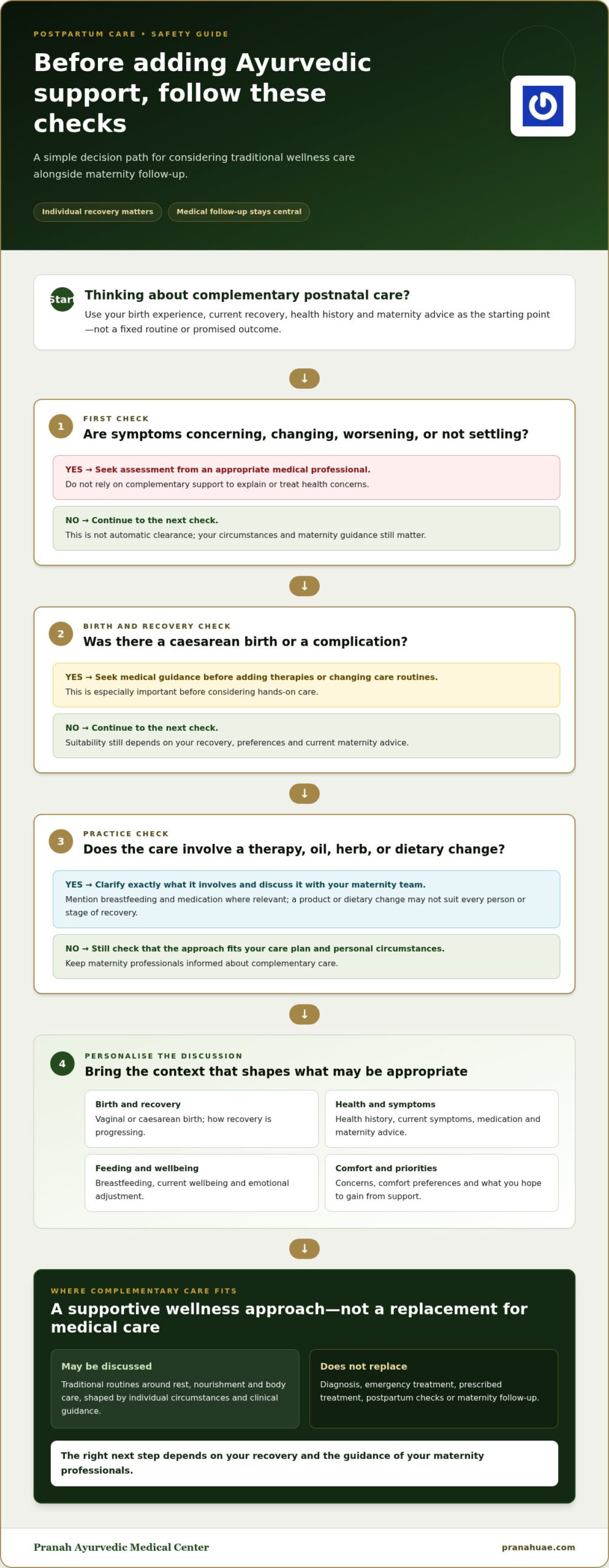
Ayurveda is a traditional health system, and its postpartum approach reflects traditional principles. It does not replace clinical assessment. A discussion about complementary care should take account of the mother’s health history, birth experience, current concerns, and maternity guidance. After a caesarean birth or a complication, or if symptoms persist or worsen, seek medical guidance before adding therapies or changing care routines.
Wellness care has a different role: it can provide a structured space to discuss comfort and personal preferences. It doesn’t diagnose postpartum conditions, provide emergency treatment, or replace maternity follow-up. For wider information on recovery and clinical context, see this postnatal care recovery guide.
Before considering a specific practice, clarify what it involves and whether it fits your current care plan. This matters especially for hands-on therapies, herbal products, and dietary changes, which may not suit every person or stage of recovery. Keep your maternity professionals informed about complementary care so decisions can take your circumstances into account.
- Traditional principles: May shape routines around rest, nourishment, and comfort.
- Individual circumstances: Health, birth experience, preferences, and clinical advice inform what may be appropriate.
- Clinical boundaries: Wellness support doesn’t replace diagnosis, emergency care, or postpartum medical follow-up.
The most useful starting point is a conversation grounded in your own recovery, not a promise based on a traditional practice. Understanding the distinction helps you explore support thoughtfully while keeping medical care central.
How is postnatal Ayurvedic care individualised for mothers in Abu Dhabi?
Postpartum care needs individual attention because every mother’s recovery, health history, comfort, and priorities are different. An individualised conversation can clarify what someone hopes to gain from complementary support and what requires clinical advice. It also avoids treating a particular therapy, diet, or schedule as a universal solution.
For mothers exploring postnatal Ayurvedic care UAE options, personalisation starts with listening and relevant context. A practitioner can consider the mother’s birth experience, current wellbeing, and preferences alongside existing maternity guidance and health concerns. The goal is a discussion tailored to the person, not a promise of a standard outcome.
Which personal circumstances can shape a care discussion?
Useful context includes whether the birth was vaginal or by caesarean, how recovery is progressing, current symptoms, breastfeeding, medication, and advice from maternity professionals. For example, a mother who is breastfeeding may want to discuss a proposed product or dietary change, while someone recovering from surgery may need medical guidance before considering hands-on care. Neither situation has a one-size-fits-all protocol.
Before a discussion, note what feels comfortable, what concerns you, and what guidance you’ve received. If symptoms are concerning, changing, or not settling, seek assessment from an appropriate medical professional rather than relying on complementary support to explain or treat them.
How can traditional care complement maternity follow-up?
Ayurvedic support can sit alongside maternity care as a complementary wellness approach. Sharing information about proposed therapies, products, or changes in routine can help the mother and her care professionals consider questions in context. Traditional support should not replace prescribed treatment, postpartum checks, or medical assessment when a health concern arises.
Abu Dhabi’s Department of Health has published an Integrated Postnatal Care Programme in Abu Dhabi. This local reference highlights the broader context of postnatal care. If you’re unsure whether a complementary practice fits with your recovery or treatment, raise the question with your maternity team before proceeding.
Organise the conversation around four areas:
- Birth and recovery: Describe the birth experience and how you’re feeling now.
- Health context: Share relevant history, medication, symptoms, and maternity advice.
- Personal priorities: Explain your comfort preferences and the kind of support you’re considering.
- Open questions: Identify any therapy or routine you’d like to discuss with your maternity team.
At Pranah Ayurvedic Medical Center on Hamdan Street in Abu Dhabi, qualified Ayurvedic doctors provide prenatal and postnatal care. Mothers can explore individualised postnatal Ayurvedic care while keeping maternity follow-up central.
Is postnatal Ayurvedic care safe after childbirth?
Postnatal Ayurvedic care may suit some mothers, but safety depends on individual health, recovery, and the specific practice being considered. A therapy that feels comfortable for one person may be unsuitable for another, particularly during recovery from surgery, with a health complication, or while taking medication. Traditional use alone doesn’t establish that a practice is safe or effective for every mother.
Safety summary: Complementary care can support personal wellness preferences, but it doesn’t replace clinical assessment, prescribed treatment, postpartum checks, or urgent medical care. The WHO Guidelines for Postnatal Care provide a clinical framework for care after birth; they should not be read as evidence that a particular Ayurvedic therapy produces a specific medical outcome.
What should mothers consider after caesarean birth or complications?
There isn’t one waiting period that applies to every mother. Recovery can depend on the birth, healing, symptoms, and advice from the maternity team. After a caesarean birth or a complication, the maternity clinician can advise whether a proposed hands-on therapy, oil, herbal preparation, or change in routine is appropriate for that person at that stage.
Share relevant details before beginning complementary care, including the type of birth, current concerns, medicines, and instructions from the maternity team. Don’t use a wellness appointment to assess a new or worsening health problem. Symptoms such as heavy bleeding, fever, severe pain, or concerns about a surgical wound need prompt medical advice; urgent or rapidly worsening symptoms require appropriate urgent care.
How should readers interpret claims about recovery and breastfeeding?
Ayurvedic traditions may describe practices in terms of comfort, nourishment, rest, or general wellbeing. Distinguish these traditional aims from proven medical effects. Don’t interpret claims as guarantees of faster healing, hormonal balance, increased milk supply, or benefits to an infant. Outcomes vary, and a traditional explanation isn’t evidence that a treatment will achieve a clinical result.
Breastfeeding makes it especially important to discuss products and therapies with qualified healthcare professionals. This includes herbal preparations, since “natural” doesn’t automatically mean safe or compatible with breastfeeding or medication. If you have questions about milk supply, feeding, pain, or a treatment’s possible effects, raise them with an appropriate maternity or healthcare professional rather than changing prescribed care on your own.
Before proceeding, make the decision specific: clarify what the practice involves, explain your health context, and consider any clinical advice. If your condition changes or you develop concerning symptoms, pause complementary care and seek medical assessment. An individual conversation helps keep traditional wellness support in its proper role, alongside, not instead of, medical care.
How can you prepare for postnatal Ayurvedic care in the UAE?
A little preparation can make a care discussion more focused and useful. If you’re considering postnatal Ayurvedic care UAE options, start with your own questions and circumstances rather than assuming you need a particular therapy or routine. The aim is to share enough context for an informed conversation while keeping maternity care and current clinical guidance central.
What information can help make a care discussion useful?
Before the discussion, note your birth experience, current concerns, breastfeeding status, medication, and relevant guidance from your maternity team. Describe your goals in your own words, such as wanting to discuss comfort or understand whether a proposed practice fits your recovery. This context supports an individualised discussion; you don’t need to arrive with a treatment already chosen.
Use this short sequence to organise your thoughts:
- Write down concerns: Note what you want to ask about and any changes in how you feel.
- Gather relevant context: Include birth and health history, medicines, breastfeeding, and maternity advice.
- Describe preferences: Explain what feels comfortable, what you’d rather avoid, and what practical support would suit you.
- Ask about the approach: Request a clear explanation of any practice being discussed and how it relates to your needs.
You don’t need to minimise discomfort or uncertainty. Clear questions help make the conversation specific. Discuss changes in symptoms or new health concerns with a maternity professional, rather than trying to manage them through self-directed treatment.
What practical needs should Abu Dhabi mothers consider?
Postpartum routines can be unpredictable, so think through practicalities as well as the care itself. Consider transport to and from the appointment, a time that fits around feeding and rest, and whether you’d like someone to accompany you or help with the baby. Plan around maternity appointments, too, and choose a time when you’re likely to feel comfortable travelling and taking part in a discussion.
If your energy or comfort changes on the day, say so. Explain what feels manageable and ask for the discussion to reflect your needs. For related background on recovery, see this postnatal massage guide in Abu Dhabi.
For a clear first conversation, bring your notes and questions about how complementary support might fit alongside your existing care. Pranah Ayurvedic Medical Center on Hamdan Street in Abu Dhabi offers prenatal and postnatal care through a team of qualified Ayurvedic doctors. Explore postnatal care at Pranah as a considered next step, with maternity follow-up remaining part of your recovery plan.
Explore postnatal Ayurvedic care at Pranah in Abu Dhabi
For mothers considering postnatal Ayurvedic care in Abu Dhabi, Pranah Ayurvedic Medical Center provides prenatal and postnatal care on Hamdan Street. The centre is operated by qualified Ayurvedic doctors and combines classical Ayurvedic practice with a modern clinical approach. Mothers can discuss traditional wellness support in this setting while keeping their maternity care in view.
What can readers expect from a professional Ayurvedic care discussion?
A useful discussion starts with your needs, relevant health history, and wellness priorities. Describe what feels comfortable, what you hope to explore, and any concerns about your recovery. The conversation can then consider those details alongside your existing maternity guidance. You don’t need to arrive expecting one particular therapy or a fixed routine to be right for you.
To make the conversation clear, bring notes about your birth experience, current concerns, medication, breastfeeding, and advice from your maternity team. You can also mention practical preferences, such as areas where you would prefer extra care or anything you’d rather avoid. Sharing this information provides context for an individualised discussion; it doesn’t guarantee a particular treatment or result.
Pranah brings classical Ayurvedic practice into a modern clinical setting. For a new mother, that means the conversation can respect both traditional wellness perspectives and her current circumstances. Questions about symptoms, prescribed treatment, or whether a therapy is suitable in light of a health concern belong with the relevant maternity or healthcare professional. Ayurvedic support should complement that care, not take its place.
How can Abu Dhabi mothers take a next step?
Start by reviewing what you want to discuss, keeping any existing maternity advice accessible, and considering whether your current recovery makes a visit comfortable. If your health changes or a concern becomes urgent, prioritise medical care rather than a wellness discussion. A postnatal consultation is an opportunity to explore supportive care in context, not a substitute for assessment of a new or worsening symptom.
Pranah Ayurvedic Medical Center on Hamdan Street in Abu Dhabi offers a local setting for mothers interested in discussing postnatal care with qualified Ayurvedic doctors. Learn about the centre and its care, then consider how a conversation may fit alongside your maternity follow-up. There’s no need to assume a particular practice is required; your priorities and clinical guidance can help shape what you discuss.
Approach postnatal support at your own pace. Bringing your questions to a professional setting can help you understand the approach and make a considered decision that respects your preferences without losing sight of medical care. Explore postnatal care at Pranah.
Choose a Postpartum Path That Respects Your Needs
Your next step doesn’t need to be a commitment to a particular treatment. It can simply be a chance to ask questions, understand what complementary support involves, and consider whether it feels appropriate for you at this stage of recovery. Let your comfort and priorities guide the conversation, while keeping maternity follow-up and clinical advice part of your care.
Exploring postnatal Ayurvedic care UAE mothers may consider is most useful when it begins with an open discussion, rather than assumptions about what every new mother needs. Take time to reflect, raise concerns, and decide what feels right for your circumstances. If a health concern changes or needs assessment, contact your maternity professional rather than relying on wellness care.
When you’re ready to explore a supportive next step, explore postnatal care at Pranah. A thoughtful conversation can help you move forward with greater clarity and care for yourself at your own pace.
Frequently Asked Questions
Is postnatal Ayurvedic care safe after a caesarean birth?
It may be appropriate to discuss, but safety depends on your recovery, health, and the specific practice. For example, tell your maternity clinician about discomfort around the incision or limits on movement before considering hands-on care. Don’t use a general online schedule to decide when to begin. Follow individual clinical advice, continue postpartum checks, and seek medical assessment if symptoms worsen.
Can I receive Ayurvedic postnatal care while breastfeeding?
Breastfeeding doesn’t automatically rule out every complementary practice, but it also doesn’t make every product or therapy suitable. If an approach involves an oil, topical product, or herbal preparation, share its ingredients or label with a qualified healthcare professional and explain any medicines you take. Discuss feeding concerns with an appropriate professional, too. Ayurvedic care shouldn’t be treated as a guaranteed way to increase milk supply.
How soon after childbirth can I begin postnatal Ayurvedic care?
There’s no single start date that fits every mother or every type of care. Your readiness may depend on how you’re recovering, whether there were complications, and what the proposed practice involves. Ask your maternity team for guidance that reflects your situation, rather than following a generic schedule. If you’re unwell or unsure about a new symptom, address that concern before arranging complementary wellness care.
What happens if I have pain or unusual symptoms after childbirth?
New, severe, persistent, or worsening symptoms need medical assessment, not a wellness treatment. Contact your maternity care team for advice, or use local urgent medical services if the situation is serious. For example, difficulty breathing, chest pain, heavy bleeding, or a high fever should not wait for a complementary appointment. Ayurvedic support should never delay assessment or treatment of a possible health problem.
Does Ayurvedic postnatal care guarantee faster recovery or improve lactation?
No. Traditional wellness practices shouldn’t be presented as a guarantee of faster healing, increased milk supply, hormonal changes, or a particular outcome for the baby. Recovery and breastfeeding experiences differ, and individual concerns deserve appropriate clinical attention. If you’re worried about healing or feeding, discuss the issue with a qualified healthcare professional. Treat complementary care as possible wellness support, not as a replacement for medical advice.
What should I share before a postnatal Ayurvedic care discussion in Abu Dhabi?
Share your birth experience, current concerns, breastfeeding status, medicines, and any relevant advice from your maternity team. For postnatal Ayurvedic care UAE mothers are considering, it can also help to bring the packaging or ingredient list for any product you’re asking about. Explain your comfort preferences and the support you hope to explore. If symptoms are urgent or worsening, seek medical care rather than waiting for a wellness discussion.