Can a natural remedy for spondylitis ease pain and stiffness without putting essential medical care at risk? When symptoms disrupt daily life, it’s understandable to look for gentler ways to feel more comfortable, especially when online claims promise more than the evidence can support.
Natural approaches may have a supportive role, but they aren’t cures and shouldn’t replace care from a rheumatologist or changes to prescribed treatment. What helps one person may not suit another. Massage, movement, dietary changes, and herbal products can also carry risks or interact with medication.
This guide explains what evidence can and can’t tell us about common supportive options, how to approach them safely, and which questions to discuss with your rheumatologist. It also explains how an Ayurvedic consultation in Abu Dhabi can help you consider complementary care alongside your needs and existing treatment. The aim is a thoughtful, coordinated path toward day-to-day comfort, not a substitute for medical care.
Key Takeaways
- A natural remedy for spondylitis may support comfort, but claims that it changes the disease need careful scrutiny.
- Compare movement, relaxation, massage, and dietary changes by their intended role, evidence limits, and personal safety considerations.
- Before trying a complementary practice or supplement, clarify your goal and discuss possible risks with your healthcare team.
- Track changes in symptoms and daily function so you can assess whether an approach is useful and review it with your clinician.
- Learn how an individualized Ayurvedic consultation and therapeutic massage at Pranah in Abu Dhabi can support a broader wellness plan.
What does a natural remedy for spondylitis mean, and what can it realistically do?
Ongoing pain and stiffness can make ordinary routines feel demanding. It’s understandable to look for ways to feel more at ease, whether through movement, relaxation, massage, or changes to daily habits. In this article, a natural remedy for spondylitis means a complementary practice intended to support comfort or wellbeing, not a replacement for diagnosis or medical treatment.
The distinction matters because “spondylitis” can refer to inflammatory conditions affecting the spine, while back pain has many possible causes. A practice that helps someone relax or move more comfortably doesn’t necessarily control inflammation or change the course of an inflammatory disease. Symptom support may improve comfort, but it isn’t the same as treatment that controls spinal inflammation.
What is axial spondyloarthritis?
Axial spondyloarthritis (axSpA) is an inflammatory condition that primarily affects the spine and the joints connecting the spine to the pelvis. Ankylosing spondylitis is part of the axSpA spectrum. The term generally refers to a form with changes visible on X-rays. Inflammatory back pain may involve persistent discomfort and stiffness, often after rest, but these features alone don’t establish a diagnosis. The Ankylosing Spondylitis Overview offers further background on the condition.
Not every backache is spondylitis. A clinician considers the pattern of symptoms, medical history, and examination findings. Assessment may also include imaging, such as X-rays or MRI, and blood tests. No single symptom or test result should be treated as a stand-alone answer. Findings are interpreted together to guide diagnosis and care.
What can a natural approach, and not, promise?
Consider complementary care in terms of the goal it may support. Gentle movement may help maintain function, while relaxation practices or appropriately adapted massage may support ease and wellbeing for some people. Results vary, and evidence for many complementary approaches in spondylitis is limited. Feeling relief doesn’t prove that the underlying inflammation is controlled.
No natural remedy is established as a cure for axial spondyloarthritis or as a replacement for clinician-directed treatment. Approach claims that a diet, herb, massage, or other practice can stop disease progression or prevent spinal fusion with caution. Some approaches may also be unsuitable or interact with medication, so discuss them with your treating clinician before starting, particularly if you have active symptoms or other health conditions.
A practical way to assess supportive care is to ask whether it helps with a specific daily goal, such as getting moving more comfortably or feeling more relaxed, without compromising medical care. Keep prescribed treatment unchanged unless your clinician advises otherwise. The following sections compare common approaches, their realistic role, and considerations for using them safely alongside spondylitis care.
How natural supportive care fits alongside medical spondylitis treatment
Complementary care works best within a clear medical plan, with communication between you and your care team. In inflammatory spondylitis, a rheumatologist assesses disease activity and treatment response over time. That oversight helps guide care intended to control inflammation and reduce the risk of complications. Movement, relaxation, or massage may support daily comfort, but none takes the place of clinical monitoring.
Feeling less pain does not prove that inflammation is controlled. Symptoms can fluctuate, and a soothing treatment may ease tension without showing whether the underlying condition is active. Don’t judge disease control by comfort alone or adjust prescribed treatment based on short-term relief.
Why diagnosis and rheumatology follow-up matter
Back and spinal symptoms can have different causes, and the right care depends on an accurate assessment. A rheumatologist can review your symptoms, examination, relevant tests, and changes over time to evaluate a diagnosis and response to treatment. Follow-up also gives you a place to raise new symptoms or concerns rather than assuming every change is part of spondylitis.
For a broader view of how complementary pain-relief approaches can sit within a considered care plan, see this Ayurvedic pain relief guide. Use it to inform, not replace, discussions with the clinician overseeing your inflammatory condition.
Where complementary practices may fit
Supportive practices have a different purpose from disease-directed treatment. A suitable movement routine may help maintain mobility, relaxation techniques may support stress management, and individualized wellness care may offer a structured way to focus on comfort. Whether a practice is appropriate depends on your health, symptoms, and current treatment. No complementary approach should be presented as proven to prevent structural changes in the spine.
Coordination makes this distinction practical. Before adding a practice, explain what you hope it will help with, how often you plan to use it, and any relevant health concerns. Tell your clinicians about supplements, herbs, massage, and other therapies, since some products may interact with prescribed medicines or be unsuitable for particular conditions. Report changes in symptoms too, especially if pain, stiffness, or function worsens. Keep prescribed treatment unchanged unless your clinician advises otherwise.
At Pranah Ayurvedic Medical Center in Abu Dhabi, an Ayurvedic consultation can help you consider supportive care in light of your individual needs and existing medical care. Learn about Ayurvedic consultations and pain-relief care as wellness support alongside, not instead of, rheumatology follow-up.
Comparing natural approaches for spondylitis: benefits, limits, and safety
Natural approaches differ in purpose and risk. Judge each by what it may reasonably support, not by claims that it can treat the disease. This comparison separates possible comfort or wellbeing goals from effects that haven’t been established, such as controlling inflammation or preventing structural changes.
| Approach | Possible supportive role | Limits and safety considerations |
|---|---|---|
| Movement and posture | Clinician-guided mobility, posture work, or suitable activity may support function and everyday movement. | The right plan depends on symptoms, fitness, and clinical advice. Exercise isn’t a proven way to reverse spinal fusion or control inflammation on its own. |
| Relaxation and breathing | Relaxation practices may help with stress management and a sense of ease. | Feeling calmer doesn’t show that spondylitis inflammation is controlled or that the disease course has changed. |
| Massage and Ayurvedic care | Individualized therapeutic care may be considered for relaxation or comfort. | Massage doesn’t treat spinal inflammation. Avoid forceful spinal manipulation, which the Spondylitis Association of America warns may pose serious risks for people with ankylosing spondylitis. |
| Dietary changes | Balanced eating can support general wellbeing and day-to-day health. | No particular diet is a cure or guaranteed symptom solution. Restrictive diets may make adequate nutrition harder to maintain. |
| Herbs and supplements | Some people consider them as part of complementary care. | They can cause side effects or interact with prescribed medicines. Discuss products with a clinician before starting them. |
Movement, posture, and breathing practices
Ask your care team whether a physiotherapist-guided mobility or posture plan is appropriate for you. The goal is to find activity that suits your current symptoms and fitness, not to push through worsening pain. Gentle breathing or relaxation can be explored for comfort, but neither should be presented as a way to reverse spinal changes. Avoid adopting an online routine without considering your individual condition.
Massage, Ayurveda, diet, and supplements
Massage may feel soothing for some people, but it isn’t a treatment for spinal inflammation. If you’re considering Ayurvedic or other wellness care, discuss how it can fit with your existing plan. Choose balanced dietary habits over severe restrictions, and don’t assume a food or supplement has disease-modifying effects. Share the name and ingredients of any herb or supplement with your clinician or pharmacist so potential interactions and risks can be reviewed.
There is no single best natural remedy for spondylitis. A more useful question is whether a practice has a clear, realistic purpose, suits your health, and can be added without disrupting medical care. Track how it affects comfort and function, then review any concerns or symptom changes with your treating clinician.
A safe, practical plan for trying complementary spondylitis care
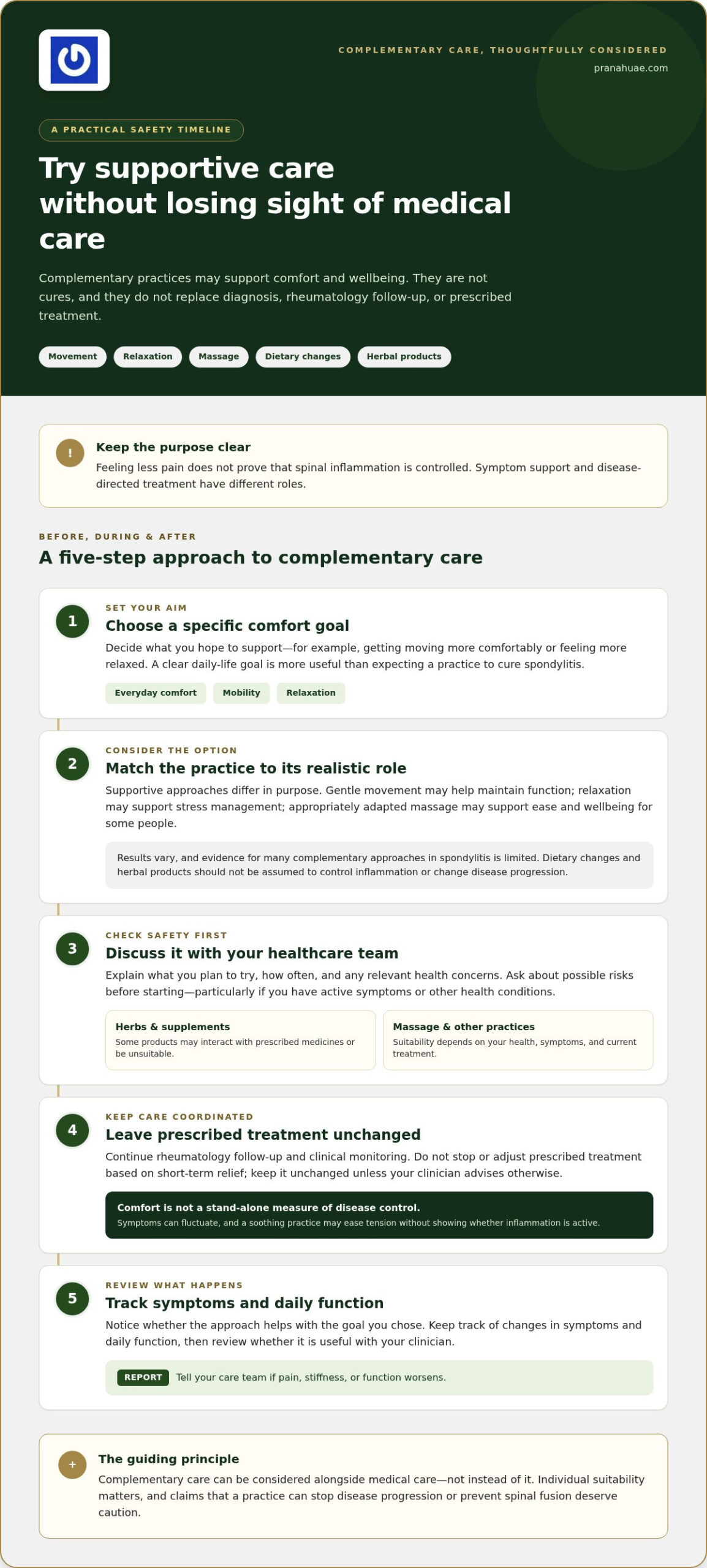
A measured approach makes it easier to assess whether a complementary practice is suitable and useful. Before adding a natural remedy for spondylitis, keep your prescribed treatment unchanged unless your clinician advises otherwise. Use these steps to make the decision collaboratively and notice both benefits and problems.
- Clarify your goal. Choose a specific supportive aim, such as easing tension or making a daily activity feel more manageable. Don’t use symptom relief as a measure of whether inflammation is controlled.
- Discuss the practice. Tell your treating clinician what you’re considering, how it will be done, and how often. Ask whether it suits your diagnosis and current symptoms.
- Check for risks. Review possible medication interactions, other health conditions, pregnancy, and any relevant precautions. For herbs or supplements, share the product name and ingredient list before use.
- Track changes consistently. Record pain, stiffness, and daily function, along with when you tried the practice. Note unwanted effects as well as any perceived benefit.
- Review the experience. Discuss your notes with your clinician and decide together whether to continue, adapt, or stop the complementary practice. Don’t change prescribed medicines on your own.
Questions to discuss before starting a remedy
Prepare a few direct questions: Is this practice appropriate for my diagnosis and symptoms? Could it interact with my medicines or affect another health condition? Are there precautions because I’m pregnant or receiving other treatment? What supportive goal is realistic, and how should we review progress or unwanted effects? Clear answers help keep complementary care aligned with your overall plan.
When symptoms need medical attention
New, worsening, or unexplained symptoms deserve prompt clinical advice rather than an experiment with self-care. Sudden vision changes or a painful red eye need urgent medical assessment, as they may signal a problem requiring timely attention. Don’t try massage, supplements, or other home approaches instead of seeking medical evaluation for potentially serious symptoms.
Seek prompt clinical advice for new or worsening symptoms, and urgent assessment for a painful red eye or sudden changes in vision. If you’re considering Ayurvedic supportive care, a consultation can help frame your goals and personal needs alongside your existing medical care. You can explore an Ayurvedic consultation at Pranah as a complementary wellness option, not a replacement for rheumatology follow-up.
Ayurvedic supportive care at Pranah in Abu Dhabi
Pranah Ayurvedic Medical Center in Abu Dhabi offers Ayurvedic consultations, therapeutic massage, and clinical pain-relief services. This care provides an individualized approach to comfort and wellbeing, informed by each person’s needs. It is not a treatment for the inflammation or structural changes associated with spondylitis.
This distinction allows traditional approaches to be considered thoughtfully. The purpose is not to replace rheumatology care, but to explore whether a supportive practice has a suitable place alongside it. Keep complementary care coordinated with ongoing medical guidance and prescribed treatment.
An individualized approach to supportive wellness
People experience pain, stiffness, and everyday limitations differently. An Ayurvedic consultation offers an opportunity to discuss personal wellness needs and consider supportive care in that context. Pranah’s qualified Ayurvedic doctors integrate classical Ayurvedic knowledge with modern medical precision, bringing an individualized perspective to the conversation. Share your comfort goals, current symptoms, and existing medical care so the discussion stays relevant to your circumstances.
Pranah offers therapeutic massage, including spine massage, as a wellness measure for relaxation or comfort when appropriate. It should not be understood as a method to control spinal inflammation, prevent spinal fusion, or change the course of spondylitis. Results aren’t promised: suitability and experience can vary, and massage shouldn’t replace assessment or care from a rheumatologist.
If you’re considering a session, be clear about what you hope to support, such as feeling more relaxed. Share important symptoms or health considerations during the consultation. If a practice causes discomfort or symptoms worsen, stop and seek advice from your treating clinician. Keep prescribed medicines and your rheumatology plan unchanged unless your clinician recommends a change.
Coordinating Ayurvedic care with your medical plan
Complementary care is safest when the clinicians involved understand what you’re trying. Keep your rheumatologist informed about Ayurvedic treatments, massage, and any herbs or supplements you’re considering. This gives your medical team a clearer picture of your overall care and an opportunity to discuss suitability in light of your diagnosis, symptoms, and medication. Ayurvedic support and rheumatology follow-up have distinct roles; one should not be treated as a substitute for the other.
Pranah Ayurvedic Medical Center is located on Hamdan Street in Abu Dhabi. If you’re considering a natural remedy for spondylitis as supportive wellness, a consultation can help frame the discussion around your individual needs and existing medical care. Read about deep tissue massage in Abu Dhabi as one of the center’s therapeutic massage services.
Choose a thoughtful next step
Your next step doesn’t need to be a dramatic change. Choose one supportive goal that matters in daily life, discuss it with your rheumatologist, and consider whether a complementary approach fits your care plan. A natural remedy for spondylitis calls for realistic expectations and careful coordination, not a substitute for medical guidance.
For those interested in an Ayurvedic perspective, Pranah’s qualified Ayurvedic doctors offer consultations, clinical pain-relief services, and therapeutic massage in Abu Dhabi. A consultation can help you explore supportive wellness in light of your individual needs while keeping ongoing medical care central.
Book an Ayurvedic consultation at Pranah in Abu Dhabi to discuss supportive care in the context of your needs and existing medical plan.
Frequently Asked Questions
Can a natural remedy cure ankylosing spondylitis?
No natural remedy should be presented as a cure for ankylosing spondylitis. This chronic inflammatory condition needs appropriate medical assessment and management. A natural remedy for spondylitis may support relaxation or day-to-day comfort for some people, but feeling better doesn’t confirm that inflammation is controlled. Don’t stop or change prescribed treatment on your own. If you’re uncertain about a therapy, bring its details to the clinician responsible for your care.
Is exercise safe if I have spondylitis?
Movement may be appropriate, but the right activity and intensity depend on your symptoms, mobility, and overall health. Ask your treating clinician or physiotherapist for guidance before starting a new routine, particularly if your symptoms have changed. For example, a plan may need adjustment if an activity aggravates pain or limits movement afterward. Avoid pushing through severe or unusual pain, and don’t treat exercise as a replacement for medical care.
Can massage help with spondylitis pain?
Massage may offer relaxation or temporary comfort for some people, but it doesn’t cure spondylitis or control spinal inflammation. Its suitability depends on your diagnosis, current symptoms, and the techniques used. Discuss it with your healthcare team before booking, especially if symptoms are flaring or you have another health concern. Be clear about any discomfort during treatment, and keep your prescribed plan in place unless your clinician recommends a change.
Are herbal remedies safe to take with spondylitis medication?
Not automatically. Herbs and supplements can cause side effects or interact with prescribed medicines, and products may differ in ingredients or strength. Before taking one, show your doctor or pharmacist the exact product label, ingredients, and intended dose. Don’t substitute a supplement for prescribed medication. If you notice a new symptom after starting a product, seek medical advice about what to do next rather than adding another remedy to address it.
Does diet affect ankylosing spondylitis?
A balanced diet can support general health, but no specific diet should be treated as a cure for ankylosing spondylitis. Nutritional needs vary, particularly for people managing other health conditions. Be cautious of restrictive plans that remove whole food groups or promise to stop inflammation or spinal changes. Before making a major dietary change, discuss it with a healthcare professional, especially if it could affect your nutrition or the way you take medication.
What happens if I stop my prescribed spondylitis treatment and use natural remedies instead?
Stopping prescribed treatment may leave symptoms or inflammation less well managed, though the effects differ between people and treatments. Don’t stop, reduce, or replace medication without first speaking with your treating clinician. If side effects, effectiveness, or long-term use concern you, arrange a review and describe what’s troubling you. Your care team can discuss options and determine what monitoring may be needed, rather than leaving you to manage a treatment change alone.
When should I seek urgent medical care for symptoms that seem related to spondylitis?
Seek prompt medical advice for new, worsening, or unexplained symptoms instead of relying on home remedies. A painful red eye or sudden vision changes need urgent medical assessment, as eye inflammation can occur alongside spondyloarthritis. Severe or rapidly changing symptoms also warrant clinical attention. If you believe you’re experiencing a medical emergency, contact local emergency services rather than waiting for a routine appointment or trying a complementary treatment first.