After childbirth, the most supportive routine is one that fits your recovery and medical needs. It’s natural to wonder which traditional practices may suit you, especially when time and energy are limited. Ayurvedic care for new mothers can offer individualized wellness support, but it should not replace postpartum medical care or be assumed safe for everyone.
This guide explains what Ayurvedic postnatal care may involve and how to explore it thoughtfully. You’ll learn why an individualized approach matters, what to discuss with your clinician before considering therapies or herbal preparations, and how to keep your postpartum care team informed. It also distinguishes traditional wellness support from medical treatment, so you can make decisions with greater confidence.
For mothers in Abu Dhabi, Pranah Ayurvedic Medical Center provides dedicated prenatal and postnatal care through qualified Ayurvedic doctors. Its approach brings classical Ayurvedic knowledge together with modern medical precision. The sections ahead offer a practical starting point for understanding this support and deciding what questions to raise as you adjust to life with your new baby.
Key Takeaways
- Postpartum recovery varies, so traditional wellness support should be considered complementary, not a guaranteed medical treatment.
- Ayurvedic care for new mothers should be discussed in light of your recovery priorities, symptoms, medical history, and current care.
- Suitability depends on your health and the specific therapy. Keep obstetric, primary, and emergency medical care in place.
- Before a care discussion, note your main concerns and relevant medications or clinician guidance.
- Pranah Ayurvedic Medical Center provides postnatal care on Hamdan Street in Abu Dhabi.
What Ayurvedic Care for New Mothers Means After Childbirth
Recovery after birth is different for every mother. Your physical experience, emotional wellbeing, feeding plans, rest, and clinical needs all shape what support may be appropriate. Ayurvedic care for new mothers is a traditional wellness approach to discuss alongside postpartum medical care, not a guaranteed treatment or a substitute for it.
In brief: Ayurvedic postnatal care is traditional, individualized wellness support after childbirth. It does not diagnose or treat emergencies, and it does not replace medical care.
Ayurveda is a long-standing system of health traditions with a broad range of principles and practices. A general overview of Ayurveda can provide historical context, but decisions about postnatal care should reflect your circumstances and current clinical guidance.
How Ayurveda frames postpartum wellbeing
Ayurveda takes a whole-person perspective, considering daily habits and a person’s overall sense of wellbeing. In a postnatal discussion, a practitioner may ask about comfort, rest, routine, and the support available at home. These traditional concepts describe an approach to wellness; they should not be presented as proven biomedical mechanisms or promises of recovery.
There is no single routine every mother needs to follow. The pace and type of supportive care should reflect what feels manageable and appropriate for you, rather than a fixed timeline or expectation.
Why each mother’s recovery needs individual attention
Birth experiences and recoveries vary. Someone recovering after a vaginal birth may have different needs from someone recovering after a caesarean birth, and experiences can differ within either group. Current symptoms, medications, feeding plans, medical history, and advice from a clinician all matter when considering additional support.
An individualized discussion can help clarify which wellness practices may be suitable to explore and which concerns need medical attention. It should take place alongside routine postpartum follow-up, not instead of it. Share relevant clinical guidance with the practitioner, and consult your obstetric or primary care clinician before adding a therapy or preparation if you are unsure how it fits your care plan.
What an Individualized Ayurvedic Postnatal Care Discussion Can Cover
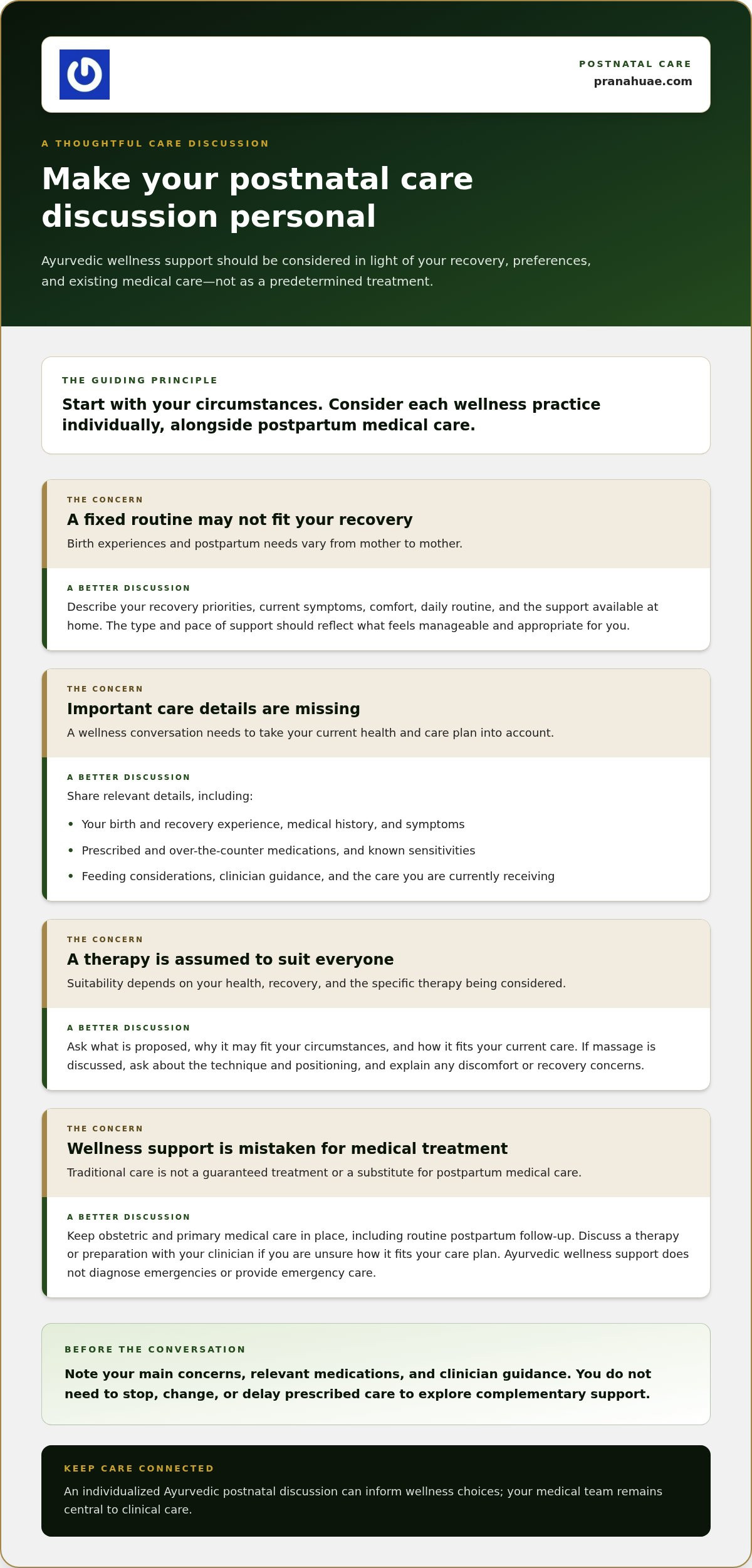
A useful postnatal care discussion starts with your circumstances, not a predetermined treatment. The aim is to understand your recovery priorities, current symptoms, and existing medical care before considering whether Ayurvedic wellness support may be appropriate. Treatment choices and timing require individualized clinical judgment.
Traditional discussions of postnatal care may refer to Sutika Paricharya. The academic review Sutika Paricharya: An Ayurvedic Approach to Postnatal Care offers background on this traditional approach. It provides context, but it does not determine what is suitable for an individual mother today.
Questions a practitioner may explore
A practitioner may ask what you hope to address, how your birth and recovery have been, and what care you are currently receiving. You can describe symptoms that affect your comfort or daily routine, along with relevant medical history. These details help frame the discussion, but they do not replace clinical diagnosis or follow-up.
Be ready to mention prescribed and over-the-counter medications, known sensitivities, and feeding considerations that may affect your choices. You do not need to stop, change, or delay prescribed care to explore complementary support. If a proposed option could affect your existing plan, discuss it with your clinician before proceeding.
How supportive therapies should be considered
Consider each therapy in relation to your health, recovery, preferences, and clinician guidance. Massage may be one topic to discuss, but it is not automatically suitable for every mother or at every stage of recovery. Ask what a proposed session involves, including the technique and positioning, and explain any areas of discomfort or relevant recovery concerns. A practitioner’s assessment can inform the conversation, while your medical team remains central to decisions about clinical care.
Use the discussion to clarify what is being proposed, why it may suit your circumstances, and how it fits with your current care. No article can prescribe an appropriate oil, herbal preparation, massage technique, or schedule for you. For a broader overview of clinical recovery support, see Postnatal Care in Abu Dhabi: Clinical Recovery Guide.
Pranah Ayurvedic Medical Center in Abu Dhabi provides dedicated postnatal care through qualified Ayurvedic doctors. Explore Ayurvedic postnatal care at Pranah to learn about its approach.
Is Ayurvedic Care Safe After Childbirth? Suitability, Limits, and Medical Support
There is no single answer for every mother. Whether Ayurvedic care for new mothers is suitable depends on your health, recovery, and the specific therapy being considered. A practice that feels supportive for one person may be inappropriate for another, particularly when symptoms, complications, medication, or feeding considerations are involved.
Ayurvedic wellness support may complement recovery, but it does not diagnose medical conditions, replace treatment, or provide emergency care. Keep obstetric and primary medical care in place, and discuss complementary therapies with your clinical team as part of your overall care.
When to pause and seek medical advice
If you have symptoms that concern you, a known complication, or a change in your recovery, pause plans for a wellness therapy and contact your obstetric or primary care team for guidance. They can assess your situation and advise whether additional support is appropriate. Do not use a wellness appointment to evaluate symptoms that may need medical attention.
If symptoms feel urgent or severe, or you believe you may be experiencing an emergency, contact local emergency services rather than waiting for a wellness appointment. Ayurvedic support is not an emergency service and should never delay urgent medical assessment.
Questions about massage, herbs, and breastfeeding
Ask about the specific therapy being considered rather than assuming a traditional practice is suitable for everyone. For massage, discuss whether it fits your health and recovery circumstances. For any oil or herbal preparation, share known sensitivities and current medications, and ask about ingredients and their relevance to your feeding plan. Safety cannot be assumed from a product’s traditional use or natural origin.
Keep your medical team informed, especially if you are breastfeeding, taking prescribed medication, or receiving care for a complication. Do not stop or change medication, start self-treatment, or delay recommended follow-up to try a complementary approach. If you are uncertain about a therapy or preparation, discuss it with a qualified clinician before using it.
An informed decision takes account of both wellness preferences and medical needs. A practitioner’s assessment can guide discussion of wellness support, while diagnosis, treatment decisions, and urgent concerns remain within medical care. This distinction lets you explore traditional practices without losing sight of the clinical support postpartum recovery may require.
Preparing for Ayurvedic Postnatal Care in Abu Dhabi
A little preparation can make a first discussion clearer, even if you have only a few minutes. Identify what you would like support with, note relevant medical context, and prepare to discuss how any proposed approach fits your care. Ayurvedic care for new mothers should be considered in coordination with your existing postpartum care, not as a replacement for it.
A simple preparation checklist for a first discussion
You do not need to prepare a detailed file. If helpful, bring or note:
- Your main recovery questions and any current symptoms you would like to discuss.
- Relevant birth and medical history, along with existing care instructions or clinician guidance.
- Current medications, allergies, or sensitivities that may matter when considering a therapy or preparation.
- Feeding considerations you want included in the discussion.
Share the information relevant to your care. If you are tired or short on time, start with your main concern and mention that other details can be discussed as needed. The purpose is to support a thoughtful conversation, not to complete a perfect checklist.
Coordinating wellness support with postpartum care
Keep your obstetric or primary care team involved in decisions about your recovery, and continue recommended follow-up. A first discussion with an Ayurvedic practitioner can clarify your goals, explain what support may involve, and establish boundaries before any therapy is considered. If a therapy or preparation raises questions about your health or current care, pause and discuss it with your clinician.
If pain is one of your concerns, you can also read the Ayurvedic Pain Relief in Abu Dhabi guide for related context. A guide or wellness discussion can help you prepare questions, but neither guarantees a particular clinical result or takes the place of medical assessment.
In Abu Dhabi, Pranah Ayurvedic Medical Center on Hamdan Street provides dedicated postnatal care through qualified Ayurvedic doctors. Explore individualized Ayurvedic postnatal support at Pranah.
Explore Ayurvedic Postnatal Care at Pranah in Abu Dhabi
For mothers in Abu Dhabi considering traditional wellness support after childbirth, a local, practitioner-led discussion can turn general questions into a more personal conversation. Pranah Ayurvedic Medical Center is located on Hamdan Street and provides dedicated prenatal and postnatal care through qualified Ayurvedic doctors.
Pranah’s approach brings classical Ayurvedic wisdom together with modern medical precision. A postnatal discussion gives you a setting to describe your priorities, share relevant health context, and understand how supportive care may fit alongside your existing postpartum plan. It does not mean every mother will need or be suited to the same therapy, and it does not guarantee a particular result.
What local, practitioner-led support can offer
Meeting with a qualified Ayurvedic doctor gives you an opportunity to discuss your individual circumstances directly. You might raise questions about comfort, daily wellbeing, or which forms of postnatal support may be appropriate to explore. The practitioner can consider your situation and discuss wellness options within the scope of the conversation, rather than relying on a routine that assumes every mother has the same needs.
This support remains complementary. Continue recommended postpartum follow-up with your obstetric or primary care team, and involve them in questions about symptoms, medication, complications, or whether a particular therapy fits your medical care. Ayurvedic care for new mothers can be explored thoughtfully without treating it as a substitute for clinical assessment or treatment.
Choosing a thoughtful next step
You do not need to have every question resolved before seeking information. Start with what matters most, such as understanding the type of support available or how a discussion can take your current care into account. If you are tired or short on time, a few key questions are enough to begin.
To explore Pranah’s prenatal and postnatal care and its Abu Dhabi location, view Pranah’s care and location information. Use the information to consider whether a practitioner-led discussion is relevant to your needs, while keeping your medical team involved in recovery decisions. Asking questions and taking time to understand your options are sensible parts of maternal self-care.
Take a Thoughtful Next Step in Your Postpartum Care
Postpartum recovery is personal, so consider any Ayurvedic support in light of your health, symptoms, feeding needs, and existing medical care. Ayurvedic care for new mothers may complement recovery as a traditional wellness approach, but it does not replace medical assessment, treatment, or emergency care.
A considered conversation can help you understand what support may suit your circumstances and what questions to raise with your clinician. You do not need every answer before you begin. Sharing your priorities and relevant care guidance is a practical first step.
Pranah Ayurvedic Medical Center provides dedicated prenatal and postnatal care through qualified Ayurvedic doctors at its clinic on Hamdan Street in Abu Dhabi. Explore Ayurvedic postnatal care at Pranah to learn about its approach and location. Keep your medical team involved as you consider your options, and give yourself room to make informed choices at your own pace.
Frequently Asked Questions
Is Ayurvedic care safe for new mothers?
Safety depends on your health, recovery, and the specific therapy being considered. Before starting, discuss your symptoms, medications, sensitivities, and feeding considerations with qualified health professionals. Ayurvedic wellness support may complement postpartum care, but it does not replace medical follow-up, diagnosis, or treatment. If symptoms feel urgent or you think you may be experiencing an emergency, seek local emergency medical help rather than relying on a wellness appointment.
When can I start Ayurvedic treatment after giving birth?
There is no single start time that suits every mother or therapy. Your birth experience, recovery, any complications, current symptoms, and medical advice all affect whether and when a particular approach may be suitable. Discuss timing with your postpartum medical team and a qualified Ayurvedic practitioner before starting. Do not treat a generic online schedule as personal guidance, and do not delay recommended follow-up or change prescribed care to begin a wellness practice.
Can I have an Ayurvedic massage while breastfeeding?
Breastfeeding alone cannot determine whether a particular massage or product is suitable. The treatment, ingredients, skin sensitivities, recovery, and individual health circumstances may all matter. Tell the practitioner you are breastfeeding and share relevant medication or health details; discuss concerns with your healthcare professional. Do not assume every oil or therapy is appropriate because it is traditional or plant-based. Seek individualized guidance before choosing a massage or applying a product.
What does Ayurvedic postnatal care involve?
Ayurvedic postnatal care is a traditional wellness approach that may begin with an individualized discussion of your recovery and wellbeing. A practitioner should consider your circumstances before discussing supportive therapies. It is not a substitute for medical diagnosis, postpartum follow-up, or emergency care. In Abu Dhabi, Pranah Ayurvedic Medical Center provides dedicated prenatal and postnatal care with qualified Ayurvedic doctors, offering a local setting to discuss whether this support may fit your needs.
Can Ayurvedic care help with postpartum pain?
Postpartum pain can have different causes, so discuss new, severe, persistent, or worsening pain with your medical team before considering wellness support. Ayurvedic care should not be treated as a guaranteed pain treatment or a replacement for diagnosis. Pranah provides clinical pain relief services, but a practitioner discussion does not replace appropriate medical assessment of postpartum pain. Follow your clinician’s advice and do not delay care to try self-treatment or a complementary therapy.
Where can I find Ayurvedic postnatal care in Abu Dhabi?
Pranah Ayurvedic Medical Center is located on Hamdan Street in Abu Dhabi and provides dedicated prenatal and postnatal care. The center is operated by qualified Ayurvedic doctors and brings classical Ayurvedic wisdom together with modern medical precision. Explore its services as a source of individualized wellness support. Keep your obstetric or primary care team involved, and continue appropriate postpartum medical follow-up as you consider your options.