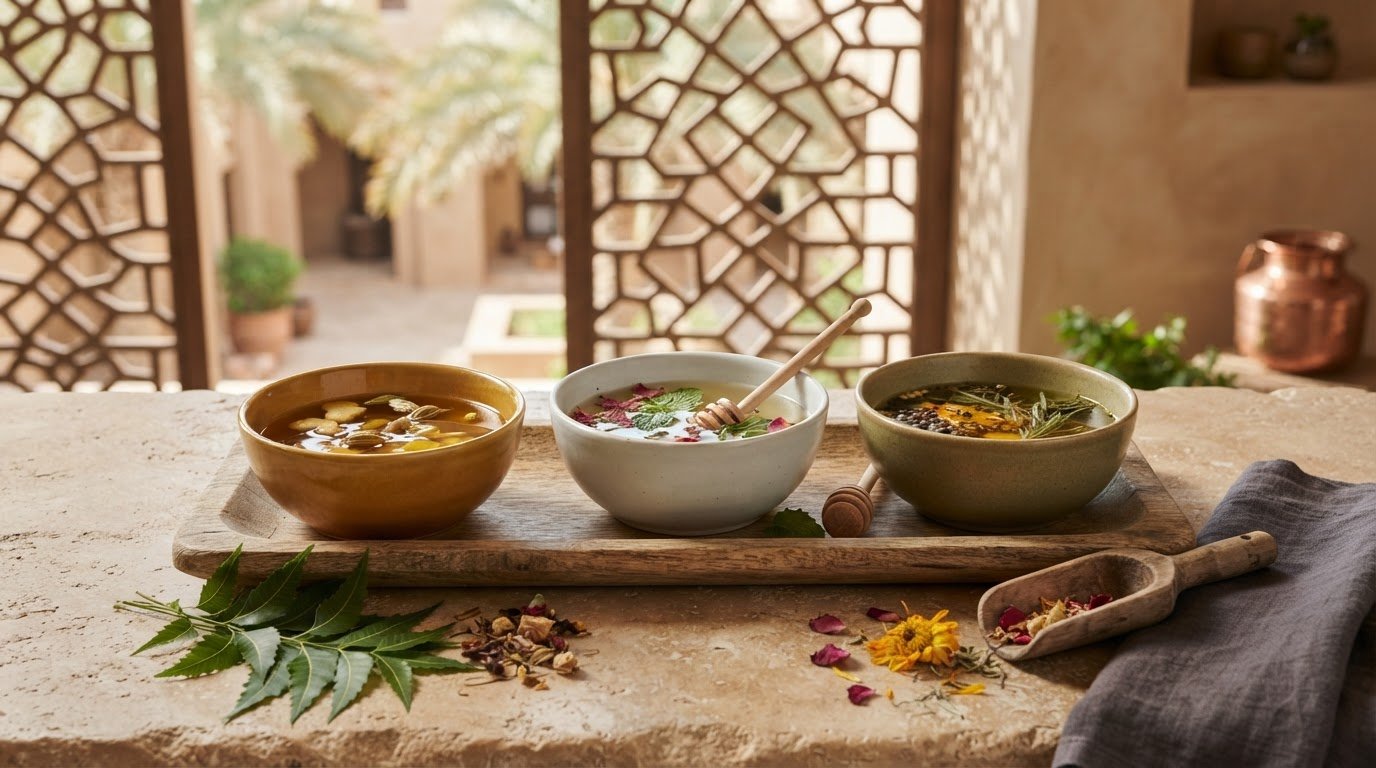
What if the oil traditionally matched to your dosha doesn’t feel right for your skin today? With abhyangam oil selection based on dosha type, traditional guidance can help you compare options, but a chart alone can’t account for personal sensitivities, preferences, or surroundings.
Ayurveda commonly pairs Vata with warming oils such as sesame or almond, Pitta with cooling choices such as coconut or sunflower, and Kapha with warming, lighter options such as mustard or safflower. These are traditional associations, not a substitute for considering how your skin responds. In Abu Dhabi’s warm climate, your comfort with an oil during and after a massage may also matter.
This guide explains traditional pairings and practical factors to weigh when choosing an Abhyangam oil. You’ll also learn when general guidance may not be enough and how individualized advice from a qualified Ayurvedic doctor at Pranah Ayurvedic Medical Center in Abu Dhabi can inform your choice.
Key Takeaways
- Learn the traditional qualities associated with Vata, Pitta, and Kapha, and the oils commonly linked to each.
- Use abhyangam oil selection based on dosha type as a starting point, then consider skin comfort, scent preference, and treatment context.
- Review ingredients and personal sensitivities rather than assuming all oils with the same base ingredient are alike.
- Use a practical selection process: clarify your purpose, consider sensitivities, and seek individualized guidance when questions remain.
- Understand how qualified Ayurvedic doctors at Pranah in Abu Dhabi can consider personal context as part of Abhyangam care.
What Does Dosha-Based Oil Selection Mean in Abhyangam?
Abhyanga is an Ayurvedic practice involving massage with oil, often described in traditional sources as using warm, dosha-specific oil. In this context, Abhyanga is a traditional wellness practice, not a medical diagnosis or a guaranteed treatment for a health condition. The term abhyangam oil selection based on dosha type describes the Ayurvedic approach of using qualities associated with a dosha as one guide when considering an oil for massage.
Ayurveda describes three doshas, Vata, Pitta, and Kapha, as a framework for understanding patterns in the body and mind. Traditional recommendations often consider whether an oil’s qualities are thought to complement or balance those associated with a dosha. This framework can help organize the discussion, but it doesn’t establish which oil is medically appropriate for every person.
How Vata, Pitta, and Kapha Are Used in Ayurvedic Tradition
In Ayurvedic descriptions, Vata is commonly associated with movement and qualities such as dryness, lightness, and coolness. Pitta is linked with transformation and qualities such as heat and sharpness, while Kapha is associated with structure, steadiness, heaviness, and coolness. These are traditional concepts, not biomedical categories or diagnoses.
You may recognize some of these descriptions in yourself, but a short online checklist cannot reliably determine your dosha or guide a personal treatment plan. Such tools can introduce the terminology, but they shouldn’t be treated as an assessment.
Why Abhyangam Oil Choice Is More Than a Dosha Label
A dosha association is a starting point, not a fixed instruction. Traditional Ayurvedic assessment may consider a person’s constitution, current circumstances, and the purpose of treatment. Practical factors matter too, including skin comfort, ingredient sensitivities, and whether the oil’s texture or scent feels suitable.
That context can change what deserves consideration. Two people who share a dosha description may have different sensitivities or treatment goals. Even one person’s circumstances and preferences may vary over time. A general chart can’t account for every detail, so it shouldn’t be read as a prescription.
General information can explain how Ayurveda traditionally connects doshas and oil qualities. Individualized clinical guidance, in contrast, requires considering the person and their circumstances. If a chart leaves you unsure, a qualified Ayurvedic doctor can help interpret the traditional framework in context. The aim is thoughtful selection, not self-diagnosis or an assumption that an oil will produce a specific health outcome.
Which Abhyangam Oils Are Traditionally Associated With Each Dosha?
Ayurvedic oil guidance often pairs an oil’s perceived qualities with those traditionally associated with a dosha. The examples below are reference points, not clinical evidence or universal instructions. The guide to Ayurvedic massage oils offers an overview of commonly cited pairings, though recommendations can differ among traditions and formulations.
| Dosha | Qualities traditionally considered | Commonly cited oil examples |
|---|---|---|
| Vata | Warming, grounding, and nourishing | Sesame; sometimes almond |
| Pitta | Cooling and soothing | Coconut; sometimes sunflower |
| Kapha | Warming and relatively light or stimulating | Safflower; mustard in some traditional guidance |
Vata and Pitta: Commonly Cited Oil Qualities
Traditional association: Sesame oil is commonly linked with Vata in Ayurvedic guidance that favors warming, grounding oils. Almond oil is another example found in some summaries. These pairings describe traditional qualities; they don’t establish that sesame or almond oil suits everyone described as Vata.
Traditional association: Coconut oil is commonly linked with Pitta because of its cooling quality in Ayurvedic descriptions. Sunflower oil is also cited in some guidance. Neither association guarantees comfort or suitability for every person.
Kapha: Considering Oil Qualities Without Overgeneralizing
Ayurvedic descriptions often favor warming, lighter, or stimulating qualities for Kapha. Safflower and mustard appear as examples in some traditional oil guidance, but they aren’t universal recommendations. Individual sensitivities and the particular formulation matter, and a traditional quality is not a safety assessment.
Oil names alone don’t tell the whole story. A preparation may contain additional ingredients, and formulations can vary across sources and practitioners. For abhyangam oil selection based on dosha type, use the table to understand common traditional associations, then consider the specific oil and your personal circumstances rather than relying on a label alone.
If general guidance leaves you uncertain, a qualified Ayurvedic doctor can consider your individual context as part of Abhyangam care. Pranah Ayurvedic Medical Center in Abu Dhabi offers Abhyangam with a team of qualified Ayurvedic doctors. Learn more about Abhyangam care at Pranah.
How to Compare Abhyangam Oils Beyond Dosha Type
Traditional dosha associations can narrow the options, but they can’t determine a universally suitable oil. For abhyangam oil selection based on dosha type, compare the traditional framework with practical factors: how your skin responds, which textures and scents you find comfortable, and whether the oil is for home use or a practitioner-led session. The California College of Ayurveda’s Abhyanga Massage for Each Dosha discusses traditional pairings. These are educational references, not a substitute for individual assessment.
Skin Sensitivity, Ingredients, and Personal Comfort
Start with what you already know about your skin. If you have a known allergy or sensitivity, review the full ingredient information before applying an oil. Formulations may combine a base oil with herbs, fragrances, or other ingredients, so the base-oil name alone may not describe the complete preparation. Don’t assume products with the same main oil have identical ingredients or composition.
Scent, thickness, and how an oil feels on your skin are practical preferences. They don’t reveal your dosha or indicate that a product is medically suitable. If irritation develops, stop using the oil and seek appropriate advice, especially if symptoms are persistent or concerning.
Climate and Treatment Context in Abu Dhabi
In Abu Dhabi, warmth may affect how comfortable a particular oil feels during a massage or afterward. Treat this as a personal comfort consideration, not a rule that assigns a dosha or determines which oil you should use. Your preference may depend on the setting, the amount applied, and how your skin feels that day.
Home use and a practitioner-led Abhyangam session may also involve different considerations. At home, you may prioritize a texture that feels comfortable and is easy to manage in your routine. During a session, oil selection can be considered alongside the treatment purpose and your individual context. Weather alone doesn’t settle the choice.
Use these questions to compare options before selecting an oil:
- Traditional association: What qualities does Ayurvedic guidance connect with the dosha?
- Personal comfort: Do the scent and texture feel acceptable to you?
- Ingredients: Have you reviewed the formulation for known sensitivities?
- Use context: Is this for home use or part of a practitioner-led treatment?
These questions support a thoughtful choice without turning a dosha label into a prescription. If sensitivities, treatment goals, or uncertainty make the decision less straightforward, individual guidance can help put traditional associations in context.
How to Approach Abhyangam Oil Selection Safely
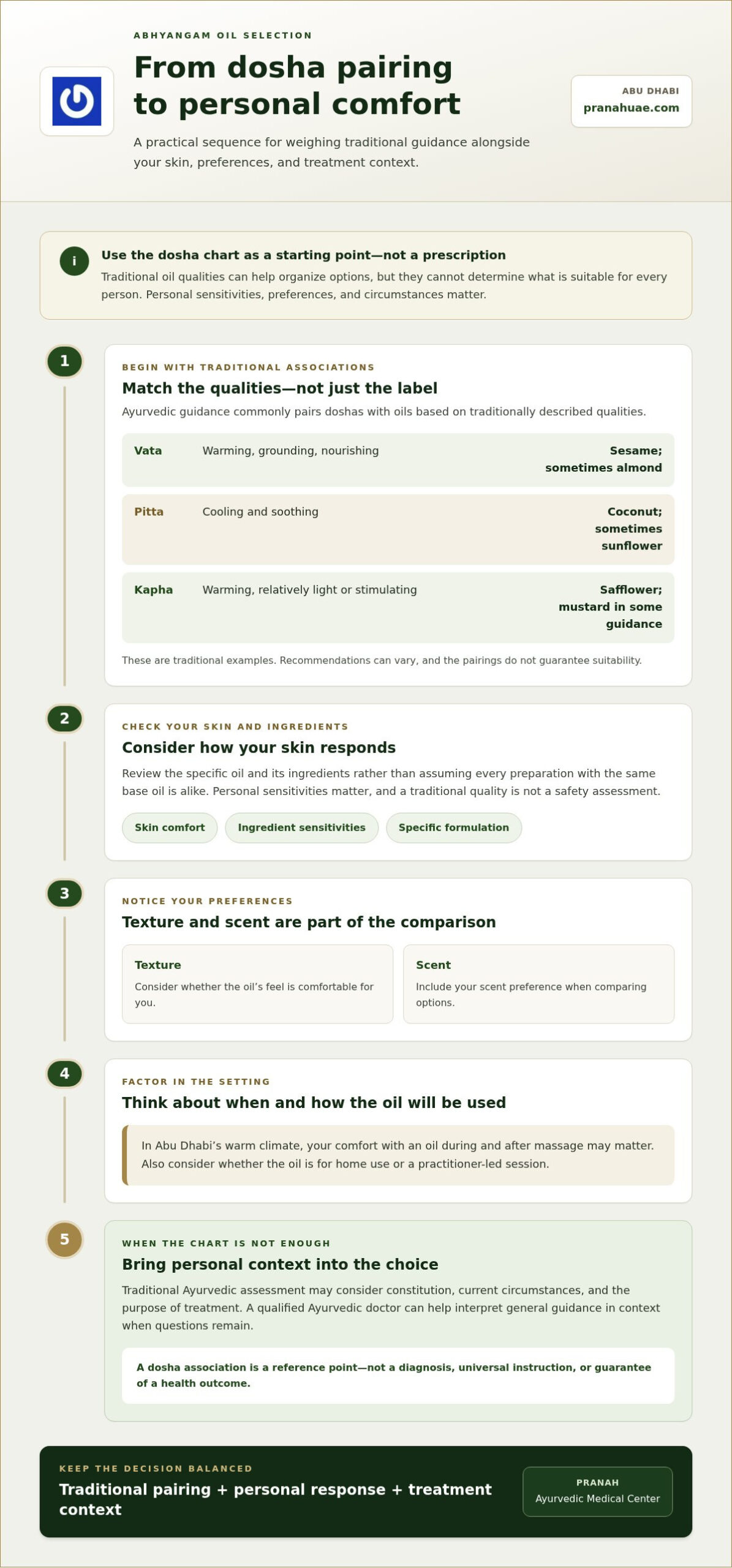
A considered oil choice starts with the person, not a dosha label. Traditional guidance can offer useful context, but it can’t diagnose your constitution, determine whether massage is suitable for you, or guarantee a health outcome. Use it as educational information, then work through a few practical checks before an Abhyangam session.
Questions to Consider Before an Oil Massage
Begin by clarifying the purpose of the massage. Are you exploring Abhyangam as part of a wellness routine, or is it being considered alongside a particular health concern? You don’t need to assign yourself a dosha to answer this. Share relevant context with the practitioner so the discussion can focus on your needs rather than an online checklist.
Next, consider sensitivities and comfort. Note any known allergies, previous reactions to oils or topical ingredients, and preferences around scent and texture. Review ingredient information, especially if the oil is a blend. A traditional association alone doesn’t establish that a formulation is suitable for your skin.
- Clarify the purpose of the massage without self-diagnosing.
- Identify known allergies, sensitivities, or past skin reactions.
- Consider which scents and textures feel comfortable to you.
- Discuss these details with a practitioner before settling on an oil.
When Individual Ayurvedic Guidance Matters
Seek individualized professional advice if general dosha guidance leaves you uncertain, or if you have an ongoing health concern, pregnancy, or active skin irritation. These circumstances can affect whether massage or a particular oil is appropriate, so a general chart shouldn’t replace a conversation about your situation. Stop using an oil if irritation develops and seek appropriate advice, particularly if symptoms persist or are concerning.
Postnatal needs also call for personal consideration rather than a one-size-fits-all recommendation. For related context, see Postnatal Care in Abu Dhabi: Clinical Recovery Guide. A qualified Ayurvedic doctor can consider relevant circumstances and treatment purpose when discussing Abhyangam. This is distinct from claiming that oil massage treats, prevents, or cures a medical condition. Abhyangam oil selection based on dosha type is a traditional framework, not a remote prescription.
For individualized guidance as part of Abhyangam care, explore Abhyangam at Pranah, where qualified Ayurvedic doctors provide care in Abu Dhabi.
Choosing Abhyangam Oil With Personalized Ayurvedic Guidance in Abu Dhabi
Traditional oil associations can help explain Ayurvedic thinking, but choosing an oil for a person is more nuanced than matching a dosha label to a chart. A qualified Ayurvedic doctor can consider relevant personal context, including the reason for seeking Abhyangam, known sensitivities, and individual comfort. This helps distinguish general education about abhyangam oil selection based on dosha type from guidance informed by a person’s circumstances.
What Individualized Abhyangam Guidance Can Clarify
General information can describe oils commonly associated with Vata, Pitta, or Kapha. It can’t determine your dosha or establish which oil is appropriate for you. In a practitioner-led discussion, explain your preferences, relevant health context, and any past reactions to oils or topical ingredients. A qualified Ayurvedic doctor can consider those details alongside traditional principles without treating a generic chart as a personal prescription.
This distinction matters if you’re unsure how a traditional recommendation relates to your needs. Individual advice can also be useful when sensitivities or treatment goals raise questions. It doesn’t mean an oil massage will treat a medical condition or produce a guaranteed result. Rather, it places the traditional practice in a more personal context.
Explore Abhyangam Care at Pranah in Abu Dhabi
Pranah Ayurvedic Medical Center offers Abhyangam in Abu Dhabi and is operated by a team of qualified Ayurvedic doctors. Located on Hamdan Street, the center provides a local setting to explore this traditional oil massage with practitioner-led care. Readers looking into related wellness topics may also find useful context in Ayurvedic Pain Relief in Abu Dhabi: A Clinical Reference Guide to Natural Healing, while remembering that educational information is not a substitute for personal clinical advice.
When general oil associations don’t answer your questions, individualized guidance can help put traditional principles in context. Explore Abhyangam at Pranah for practitioner-led care in Abu Dhabi.
Make Your Oil Choice With Confidence
Traditional dosha associations can help explain why certain oils are commonly linked with Vata, Pitta, or Kapha. They’re a starting point, not a diagnosis or a universal prescription. In practice, abhyangam oil selection based on dosha type also calls for attention to personal comfort, ingredient sensitivities, and the purpose of the massage.
If a general chart doesn’t resolve your questions, individualized guidance can help put those traditional principles in context. A qualified Ayurvedic doctor can consider your circumstances without promising a particular result or treating a dosha label as the whole picture.
Pranah Ayurvedic Medical Center offers Abhyangam in Abu Dhabi and is operated by qualified Ayurvedic doctors. Located on Hamdan Street, the center provides a local setting to explore this traditional practice with practitioner-led care. Explore Abhyangam care at Pranah in Abu Dhabi for informed, individual guidance.
Frequently Asked Questions
Which oil is traditionally used for Vata dosha in Abhyangam?
Sesame oil is commonly associated with Vata in traditional Ayurvedic guidance. Its warming and grounding qualities are often cited as a reason for this pairing. Almond oil also appears in some traditional recommendations. These associations describe Ayurvedic practice, not a clinical finding or a guarantee that an oil will suit everyone. Consider your skin comfort, ingredient sensitivities, and treatment context before choosing an oil.
Which Abhyangam oil is traditionally associated with Pitta dosha?
Coconut oil is commonly associated with Pitta in Ayurvedic tradition because it is described as cooling. Sunflower oil is another example found in some traditional guidance. These pairings are general reference points, not universal rules or medical recommendations. Individual comfort, the oil’s full formulation, and the purpose of the massage can all matter. A qualified Ayurvedic practitioner can help interpret traditional guidance in personal context.
Can I choose an Abhyangam oil based only on my dosha type?
No. Abhyangam oil selection based on dosha type can introduce traditional oil pairings, but a dosha label alone can’t determine which oil is right for you. Consider known sensitivities, ingredient information, skin comfort, and the reason for the massage. Avoid diagnosing yourself from a brief online quiz. If a general chart doesn’t address your needs, seek individualized guidance from a qualified Ayurvedic doctor.
Is coconut oil suitable for every person with Pitta dosha?
No. Coconut oil is a traditional Pitta association, not a guarantee of suitability for every person described as Pitta. The oil’s ingredients, your known allergies or sensitivities, and how your skin responds are practical considerations. A dosha category can’t predict an individual reaction. If you have a history of sensitivity or are unsure about a formulation, discuss your circumstances with a qualified practitioner before using it for massage.
How should I consider skin sensitivity when choosing massage oil?
Review the full ingredient information and avoid oils containing ingredients you know you react to. A base-oil name may not reveal every ingredient in a blend, and formulations can differ. Scent and texture are personal comfort preferences, not signs of a particular dosha. If irritation develops, stop using the oil and seek appropriate advice, especially if symptoms persist or concern you. For known skin conditions, ask a healthcare professional for guidance.
Does Abu Dhabi’s warm climate change which Abhyangam oil I should choose?
Abu Dhabi’s warmth may affect how comfortable an oil feels during or after a massage, but weather alone doesn’t determine your dosha or prescribe an oil. Consider your own comfort, the setting, and whether the massage is at home or practitioner-led. Traditional associations can inform the discussion, while personal circumstances remain relevant. If you’re uncertain, a qualified Ayurvedic doctor can help put the choice in context.
Should I seek Ayurvedic guidance before an Abhyangam massage during pregnancy?
Yes. Seek individualized advice before having an Abhyangam massage during pregnancy, and discuss massage with your maternity healthcare professional as well. Pregnancy is a personal health circumstance, so general dosha charts or oil recommendations shouldn’t determine whether massage or a particular formulation is suitable. Share relevant sensitivities and concerns with the professionals advising you. In Abu Dhabi, a qualified Ayurvedic doctor can discuss the traditional care context without replacing maternity care.